One down, one to go.
Jonathan and I both graduated from the Torrey Honors Institute at Biola University this afternoon. It was a lovely ceremony. Father David, from Blessed Sacrament, was the speaker and did a fabulous job. We also recieved our very cool silver rings with the inscription: Bonvm Veritas Pvlcher (Good, True, Beautiful).
Tomorrow morning is the big Biola graduation. It will be much longer. And much more boring. And we won't get cool rings. But we'll shake Dr. Cook's hand and be recognized as college graduates. And that's pretty cool too.
*sigh* At last.
Friday, May 27, 2005

Thursday, May 26, 2005
I'm printing my thesis. I'm pretty disappointed in it, but I learned a lot about how to write long papers, anyway.
Next a title page, then the bibliography is to be printed.
Then I guess I'll go to bed, though Dustin and I are competing at the moment to see who will stay up the longest tonight. He had said that he would go to bed at 3:00, but that time has past.
Now for graduation stuff. My first rehearsal is tomorrow: that's for Torrey.
Next time I go to work I'll be the boss. I'm looking forward to learning a lot about managment and communicating. I imagine there will be tough times, but I'm gonna head into 'em straight on!
Next a title page, then the bibliography is to be printed.
Then I guess I'll go to bed, though Dustin and I are competing at the moment to see who will stay up the longest tonight. He had said that he would go to bed at 3:00, but that time has past.
Now for graduation stuff. My first rehearsal is tomorrow: that's for Torrey.
Next time I go to work I'll be the boss. I'm looking forward to learning a lot about managment and communicating. I imagine there will be tough times, but I'm gonna head into 'em straight on!
Saturday, May 21, 2005
This morning I took the CSET (California Subject Examination Test): Multiple Subjects. It includes three subtests: 1. Language, Reading, Literature; History and Social Science 2. Math and Sciences 3. Physical Education, Human development, Visual and Performing Arts. The subtests can be taken on separate days, or all at once. I decided to take it all and get it over with. Reporting time was 7:30am, at Magnolia High School in Anaheim. When I got to the classroom where I was assigned, I took my seat and got signed it. By 7:35, everyone who was there was signed in, but we couldn't start the test till 8:00, because people would be coming in late, yadda-yadda-yadda. So we were all just sitting there, everyone pretty stressed and wanting to somehow jump five hours ahead to when the test would be over. I figured it might be nice to get out of my seat for a few minutes. So, I walked over near the door where there was a globe (we were obviously in a history classroom: maps on the walls and a poster with all the U.S. Presidents, etc.) and started slowly turning it and looking at it. I was probably up there for about 5 minutes before the lady who was administering the test came over and said, "Would you please take a seat?" I said, "Oh, sure. I just thought I'd review a little geography," and walked back to my seat. She wasn't amused, but several other people in the room chuckled and started talking, and I felt that I had helped to lighten the tension a bit.
The test itself went pretty well. I'm all but certain I passed all three subtests, and I'm very glad to have it over with. One of the essay questions was almost identical to one that I had read in my test prep book a few days ago (with a sample answer and everything) so that was great. Another essay question, in the Human Development section, dealt with something that we just talked about in my Child Development class on Thursday. There's about a thousand things they could have asked (that I would have had a much harder time writing an essay on), so to have some that I was so prepared for was an answer to prayer.
The test itself went pretty well. I'm all but certain I passed all three subtests, and I'm very glad to have it over with. One of the essay questions was almost identical to one that I had read in my test prep book a few days ago (with a sample answer and everything) so that was great. Another essay question, in the Human Development section, dealt with something that we just talked about in my Child Development class on Thursday. There's about a thousand things they could have asked (that I would have had a much harder time writing an essay on), so to have some that I was so prepared for was an answer to prayer.
Friday, May 20, 2005
"What you are stepping Westward?"
Yesterday, Libby and I stepped toward the setting sun. When Libby pointed out our westward wanderings, I replied "What you are stepping westward?" The awkward construction of the sentence fairly obscures the meaning, but it also makes it stick in my mind. The line is good, but it is not my own; it is by the masterful poet William Wordsworth. I have read it many times, and I had just read it the other day when we stepped westward ourselves. The preface of this poem, as my memory serves me, says that Wordsworth and a friend were walking in the Lake District when two well dressed ladies met them and asked them if they were stepping westward.
The experience that I had yesterday with Libby was a mirror of the experience Wordsworth had with these two ladies. The words of Wordsworth added a significance to our walk, just like the ladies' words had added significance to his walk. Isn't it amazing how a poet can take a quick interchange of words, and ring out of it a beautiful contemplation? And, while contemplating this question, be doing the thing that he's examining? Awesome.
Yesterday, Libby and I stepped toward the setting sun. When Libby pointed out our westward wanderings, I replied "What you are stepping westward?" The awkward construction of the sentence fairly obscures the meaning, but it also makes it stick in my mind. The line is good, but it is not my own; it is by the masterful poet William Wordsworth. I have read it many times, and I had just read it the other day when we stepped westward ourselves. The preface of this poem, as my memory serves me, says that Wordsworth and a friend were walking in the Lake District when two well dressed ladies met them and asked them if they were stepping westward.
VII. STEPPING WESTWARD
"What, you are stepping westward?"--"Yea."
--'Twould be a 'wildish' destiny,
If we, who thus together roam
In a strange Land, and far from home,
Were in this place the guests of Chance:
Yet who would stop, or fear to advance,
Though home or shelter he had none,
With such a sky to lead him on?
The dewy ground was dark and cold;
Behind, all gloomy to behold;
And stepping westward seemed to be
A kind of 'heavenly' destiny:
I liked the greeting; 'twas a sound
Of something without place or bound;
And seemed to give me spiritual right
To travel through that region bright.
The voice was soft, and she who spake
Was walking by her native lake:
The salutation had to me
The very sound of courtesy:
Its power was felt; and while my eye
Was fixed upon the glowing Sky,
The echo of the voice enwrought
A human sweetness with the thought
Of travelling through the world that lay
Before me in my endless way.
The experience that I had yesterday with Libby was a mirror of the experience Wordsworth had with these two ladies. The words of Wordsworth added a significance to our walk, just like the ladies' words had added significance to his walk. Isn't it amazing how a poet can take a quick interchange of words, and ring out of it a beautiful contemplation? And, while contemplating this question, be doing the thing that he's examining? Awesome.
Thursday, May 19, 2005
My Thoughts on The Revenge of the Sith
This movie is not perfect. But it exceeded my expectations, and I would qualify my expectations by saying that they had been buoyed by the positive feedback that I'd been hearing before I went. So it exceeded my a little more than modest expectations for its success, whatever that's worth. Thanks to Libby for coming with me to see it despite the late hour!
In my opinion, the movie's greatest strength was making Anakin Skywalker's character realistic. I felt that his change was, in the moral universe of the movie, natural considering his character and the decisions that he made. All this despite the bad acting on the part of Hayden Christensen. I really felt for Darth Vader's change, but at the same time, the depths to which he plummeted helped me to understand just how Obi Wan could tell Luke that Skywalker was dead. He really is so evil that it seems like the man he used to be is just totally gone.
Now I want to watch the Return of the Jedi again and see why Luke didn't change. And see how well the vision of Anakin's character returns in the last decisions of Vader's reform.
Other positives:
The movie connected with me pretty powerful on an emotional level several times. Unlike Steven Spielberg, I didn't cry, but I could see why he would. At points, and at the end, I felt sick. It's very sad.
The light-saber scenes were all enjoyable. There are things that you could complain about (Hard to see what's going on occasionally) but they were still thrilling. The Obi Wan/Anakin battle doesn't disappoint, and neither does the Yoda/ Palpatine battle.
Yoda is awesome again. His character manages to inject humor into the movie despite the totally serious themes.
Mace Windu's one light saber battle is really cool.
I thought some of the ways it weaved its ethical points around the narrative were creative and interesting. At one critical point, enemies are calling each other traitors. While it's clear at the time who is the real traitor, there's plausible amiguity within the story (Palpatine weilds power like Richard III). But by the next scene, the awful implications of that belief are brought home with the most disgusting and treacherous sequence of the whole movie. Simple and effective.
An important consideration:
It's not a children's movie. If you're under 13, don't go. It has one moment that is very graphic.
Negatives:
We see Jar Jar's face. He doesn't lose it.
Bad dialogue. At times, it's really bad.
Bad acting. How can Natalie Portman be the same actress from Garden State? This is why I think the script might be the cause of a lot of the bad acting. There are good actors in this movie. I'd say Samuel L. Jackson does the best job, overall.
Lots of computer graphics. At times it was distracting, and on the whole Lucas obviously went overboard. (on the whole though, by the end, the story had mostly removed my complaints about this)
There are some saggy moments in the plot. Generally that's because of the bad dialogue and acting that we're conscious of during the still moments.
I thought the ending was a little cheesy. It was very self-consciously making connections that would set up Episode IV. I don't think that they were justified by this movie of itself, which seems a weakness to me.
Alright. My recommendation: if you like Star Wars, you have to see it. If you don't like Star Wars at all, you might not like it. If you like fun action movies, you'll probably appreciate it.
This movie is not perfect. But it exceeded my expectations, and I would qualify my expectations by saying that they had been buoyed by the positive feedback that I'd been hearing before I went. So it exceeded my a little more than modest expectations for its success, whatever that's worth. Thanks to Libby for coming with me to see it despite the late hour!
In my opinion, the movie's greatest strength was making Anakin Skywalker's character realistic. I felt that his change was, in the moral universe of the movie, natural considering his character and the decisions that he made. All this despite the bad acting on the part of Hayden Christensen. I really felt for Darth Vader's change, but at the same time, the depths to which he plummeted helped me to understand just how Obi Wan could tell Luke that Skywalker was dead. He really is so evil that it seems like the man he used to be is just totally gone.
Now I want to watch the Return of the Jedi again and see why Luke didn't change. And see how well the vision of Anakin's character returns in the last decisions of Vader's reform.
Other positives:
The movie connected with me pretty powerful on an emotional level several times. Unlike Steven Spielberg, I didn't cry, but I could see why he would. At points, and at the end, I felt sick. It's very sad.
The light-saber scenes were all enjoyable. There are things that you could complain about (Hard to see what's going on occasionally) but they were still thrilling. The Obi Wan/Anakin battle doesn't disappoint, and neither does the Yoda/ Palpatine battle.
Yoda is awesome again. His character manages to inject humor into the movie despite the totally serious themes.
Mace Windu's one light saber battle is really cool.
I thought some of the ways it weaved its ethical points around the narrative were creative and interesting. At one critical point, enemies are calling each other traitors. While it's clear at the time who is the real traitor, there's plausible amiguity within the story (Palpatine weilds power like Richard III). But by the next scene, the awful implications of that belief are brought home with the most disgusting and treacherous sequence of the whole movie. Simple and effective.
An important consideration:
It's not a children's movie. If you're under 13, don't go. It has one moment that is very graphic.
Negatives:
We see Jar Jar's face. He doesn't lose it.
Bad dialogue. At times, it's really bad.
Bad acting. How can Natalie Portman be the same actress from Garden State? This is why I think the script might be the cause of a lot of the bad acting. There are good actors in this movie. I'd say Samuel L. Jackson does the best job, overall.
Lots of computer graphics. At times it was distracting, and on the whole Lucas obviously went overboard. (on the whole though, by the end, the story had mostly removed my complaints about this)
There are some saggy moments in the plot. Generally that's because of the bad dialogue and acting that we're conscious of during the still moments.
I thought the ending was a little cheesy. It was very self-consciously making connections that would set up Episode IV. I don't think that they were justified by this movie of itself, which seems a weakness to me.
Alright. My recommendation: if you like Star Wars, you have to see it. If you don't like Star Wars at all, you might not like it. If you like fun action movies, you'll probably appreciate it.
Monday, May 16, 2005
This past weekend, I had the privilege of taking a road trip up to the Monterey Bay Aquarium with the Marine Biology class. Now, I'm not taking Marine Biology. But the professor is the same one that teaches my Ornithology class, and he thought it would be a good chance for us to get to see some birds that we wouldn't see down here. I was the only one that took him up on the offer to tag along, and I'm very glad I did. I've actually been there once before, last spring when I took Marine Biology, but it's such an amazing place that I couldn't pass up another free trip to see it (Biola pays our admission).
We left on friday afternoon and planned to stop for dinner at In-N-Out in Santa Maria.Then, one of the students, Andrew (who is from Santa Maria), got a call from his mom saying that she wanted to have us over for dinner. So, we stopped there for a yummy meal of pizza, chopped fruit, green salad, Snapples, and freshly baked cookies. As we drove off to continue our trip up the coast, Andrew's parents stood in the driveway and waved goodbye until we were out of sight. It looked like it was straight out of Leave it to Beaver or something. So great.
We got to the camp ground after dark and set up our tents as quickly as we could. I wouldn't mention the camping bit, except that somewhat of an adventure came of it the next morning. There were two tents of girls: four in each. The girls in my tent kept our shoes inside the tent overnight. The girls in the other tent left their shoes outside. And when we got up in the morning, those four girls were each short one pair of shoes. I couldn't believe it! Somebody stole three pairs of women's flip-flops and one pair of tennis shoes (the tennis shoes were quite expensive. If it weren't for the loss of that $80 pair of shoes, it would have been completely hilarious. As it was, it was still pretty amusing.) So, we took down the tents and headed to Longs to buy flip-flops for our barefooted buddies.
Breakfast was at a place called First Awakenings, which makes the best pancakes I've ever had. One takes up the whole plate, and is enough to satisfy most hungry stomachs. If you're ever up by the aquarium, you should definitely eat there.
The aquarium itself was of course amazing. Among the best exhibits are the otters, the tuna (those guys are big and can move really fast!), and the Jellyfish exhibit entitled Jellies: Living Art. My favorite of the jellies is the Comb Jelly. It's amazing to me that something like that exists. They're simply fascinating.
I also saw a few new birds during the trip: the Yellow-billed Magpie, the Pelagic Cormorant, and the Pigeon Guillemot.
This aquarium is just great--everyone should visit it at least once in their life. It's the #1 aquarium, and the #3 top-rated family attraction in the country. So, go; take the kids.
We left on friday afternoon and planned to stop for dinner at In-N-Out in Santa Maria.Then, one of the students, Andrew (who is from Santa Maria), got a call from his mom saying that she wanted to have us over for dinner. So, we stopped there for a yummy meal of pizza, chopped fruit, green salad, Snapples, and freshly baked cookies. As we drove off to continue our trip up the coast, Andrew's parents stood in the driveway and waved goodbye until we were out of sight. It looked like it was straight out of Leave it to Beaver or something. So great.
We got to the camp ground after dark and set up our tents as quickly as we could. I wouldn't mention the camping bit, except that somewhat of an adventure came of it the next morning. There were two tents of girls: four in each. The girls in my tent kept our shoes inside the tent overnight. The girls in the other tent left their shoes outside. And when we got up in the morning, those four girls were each short one pair of shoes. I couldn't believe it! Somebody stole three pairs of women's flip-flops and one pair of tennis shoes (the tennis shoes were quite expensive. If it weren't for the loss of that $80 pair of shoes, it would have been completely hilarious. As it was, it was still pretty amusing.) So, we took down the tents and headed to Longs to buy flip-flops for our barefooted buddies.
Breakfast was at a place called First Awakenings, which makes the best pancakes I've ever had. One takes up the whole plate, and is enough to satisfy most hungry stomachs. If you're ever up by the aquarium, you should definitely eat there.
The aquarium itself was of course amazing. Among the best exhibits are the otters, the tuna (those guys are big and can move really fast!), and the Jellyfish exhibit entitled Jellies: Living Art. My favorite of the jellies is the Comb Jelly. It's amazing to me that something like that exists. They're simply fascinating.

I also saw a few new birds during the trip: the Yellow-billed Magpie, the Pelagic Cormorant, and the Pigeon Guillemot.

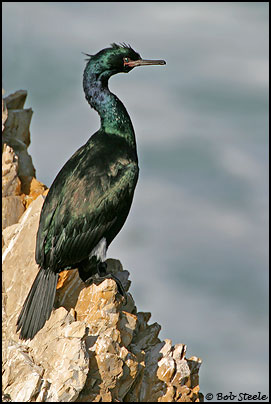

This aquarium is just great--everyone should visit it at least once in their life. It's the #1 aquarium, and the #3 top-rated family attraction in the country. So, go; take the kids.
Sunday, May 15, 2005
Libby and I are reading the Voyage of the Dawn Treader. This is one of the best of the Chronicles of Narnia, but it is also one of the strangest. There is no crisis for which the children are drawn to Narnia, yet it is done without their willing. This is unique. If one is left to consider the theme of the book, natural questions come to mind that do not in any other work. Why are the children brought to Narnia? What happens that requires them? Or are they brought there for their own sake?
I am not sure yet, though I have begun to find some answers.
Today we read the chapter about the Island where Dreams Come True. As a child, this chapter was one of the most frightening of the book, not because I could relate to any experience like it, but because it suggested to my imagination a kind of experience worse than pretty much any other could ever be. It didn't really connect with me because I always thought Lewis was wrong. I do not have nightmares that often, and have had many pleasant dreams. This time through, I noticed he did not make an exhaustive claim regarding the nature of "real dreams." The idea is just that you have some dreams that are so bad that you would never want to have the good ones come if it meant the bad ones would come true, too.
Anyway, this aside, the chapter is likely one of the best in the book, and it is also one of the most self-consciously literate.
The premise of the chapter, of course, is that the Dawn Treader is confronting a strange new adventure. For several days in front of them, a blackness they took to be an island loomed closer and closer. As they got within a few feet, they stopped rowing and would not have entered it but for the insistance of Reepicheep. He blames their reluctance on cowardice (rightly so?) and urges them further in. Why? Not for the sake of any use, he answers Drinian, but to seek out adventures for their own sake. That is, Reepicheep is convinced that one must live in such a way that, facing all life's obstacles courageously, an intrinsic good will follow if one is faithful. This strikes me as a Christian sentiment, and the chapter comes off as a very Christian meditation on fear, human evil, and salvation.
When the boat has pressed on for about five minutes (or so says Drinian) into the darkness, they hear the voice of a man who has almost lost his humanity for terror. Upon saving him, he tells them the fear of the place, and the ship immediately begins to flee. Reepicheep protests, but Caspian silences him. Why? Because there are some fears that no man can face.
It occurs to me that the fear no man can face is the fear of himself. Since a dream is a manifestation of hidden internal beliefs or lies, or what-ever, facing one is facing one's worst parts. To this task, no one is able (save perhaps the noble Reepicheep). So, the men fly. They fly as fast as they can, but it is to no avail. They cannot escape. They row longer than it should have taken to escape, but the darkness leaves them no way of finding a way out.
Up to now, the literary parrallel is that of Dante in the Dark Wood. The enterprising pilgrim attemps to reach the peak of the mountain by himself, but it is manifestations of his own sin that chases him down it. He cannot reach Paradise by his own work: it is only through the aid of the love of God that he can be granted salvation. So far, this parrallel (I imagine it is intended) is clear.
What happens next is straight from Dante. Dante is met by Virgil, but why is Virgil there? Because St. Lucy prayed for him. Lucy is the patron saint of light (her day in the Church calendar is the shortest of the year), and Lewis has his character with that name pray for their salvation. The result? Light from heaven streams down onto the ship, and descending through it is a cross-shaped bird: the albatross.
The albatross is the most obvious literary allusion in the book. It's a play on Coleridge's The Rime of the Ancient Mariner, something every English school boy of his age would have read. In the Mariner story, the albatross saves the crew of an unlucky ship that stumbles into an antarctic fog and can't get out. So, the mariner kills it. Disastrous consequences soon follow. The albatross was an innocent and a savior, and it was killed. There is no punnishment sufficeint for it, except that the mariner must work to prevent such sins from happening again for the rest of his life (his freedom is completely taken away). Anyway, I take the albatross to be some kind of image of the saving power of nature. Left there, we'd wonder why Lewis chose the image. But he didn't leave the image as he found it.
The albatross is Aslan. He makes this very clear. So, here it is not nature saving us, but God saving us. There is no doubt left in your mind that this is a natural occurence at all. I imagine that the natural imagery works to his advantage because grace perfects nature. Aslan is a better albatross than Coleridge's; he's God after all.
So, why was this chapter written? Because Lewis wants to habituate our souls into finding the truth. In this case, the truth is that we have such hideous evil within us that we will never find salvation (or more broadly perhaps moral improvement of any kind) on our own. It requires the supernatural aid of our benevolent God, and his intercessory action flowing from the life giving prayers of our loved ones. Reading a story like this will make us more likely to look for such aid when confronting difficult problems in our life. This is the sort of book Eustace should have read his whole life.
It is the "right sort of book."
I am not sure yet, though I have begun to find some answers.
Today we read the chapter about the Island where Dreams Come True. As a child, this chapter was one of the most frightening of the book, not because I could relate to any experience like it, but because it suggested to my imagination a kind of experience worse than pretty much any other could ever be. It didn't really connect with me because I always thought Lewis was wrong. I do not have nightmares that often, and have had many pleasant dreams. This time through, I noticed he did not make an exhaustive claim regarding the nature of "real dreams." The idea is just that you have some dreams that are so bad that you would never want to have the good ones come if it meant the bad ones would come true, too.
Anyway, this aside, the chapter is likely one of the best in the book, and it is also one of the most self-consciously literate.
The premise of the chapter, of course, is that the Dawn Treader is confronting a strange new adventure. For several days in front of them, a blackness they took to be an island loomed closer and closer. As they got within a few feet, they stopped rowing and would not have entered it but for the insistance of Reepicheep. He blames their reluctance on cowardice (rightly so?) and urges them further in. Why? Not for the sake of any use, he answers Drinian, but to seek out adventures for their own sake. That is, Reepicheep is convinced that one must live in such a way that, facing all life's obstacles courageously, an intrinsic good will follow if one is faithful. This strikes me as a Christian sentiment, and the chapter comes off as a very Christian meditation on fear, human evil, and salvation.
When the boat has pressed on for about five minutes (or so says Drinian) into the darkness, they hear the voice of a man who has almost lost his humanity for terror. Upon saving him, he tells them the fear of the place, and the ship immediately begins to flee. Reepicheep protests, but Caspian silences him. Why? Because there are some fears that no man can face.
It occurs to me that the fear no man can face is the fear of himself. Since a dream is a manifestation of hidden internal beliefs or lies, or what-ever, facing one is facing one's worst parts. To this task, no one is able (save perhaps the noble Reepicheep). So, the men fly. They fly as fast as they can, but it is to no avail. They cannot escape. They row longer than it should have taken to escape, but the darkness leaves them no way of finding a way out.
Up to now, the literary parrallel is that of Dante in the Dark Wood. The enterprising pilgrim attemps to reach the peak of the mountain by himself, but it is manifestations of his own sin that chases him down it. He cannot reach Paradise by his own work: it is only through the aid of the love of God that he can be granted salvation. So far, this parrallel (I imagine it is intended) is clear.
What happens next is straight from Dante. Dante is met by Virgil, but why is Virgil there? Because St. Lucy prayed for him. Lucy is the patron saint of light (her day in the Church calendar is the shortest of the year), and Lewis has his character with that name pray for their salvation. The result? Light from heaven streams down onto the ship, and descending through it is a cross-shaped bird: the albatross.
The albatross is the most obvious literary allusion in the book. It's a play on Coleridge's The Rime of the Ancient Mariner, something every English school boy of his age would have read. In the Mariner story, the albatross saves the crew of an unlucky ship that stumbles into an antarctic fog and can't get out. So, the mariner kills it. Disastrous consequences soon follow. The albatross was an innocent and a savior, and it was killed. There is no punnishment sufficeint for it, except that the mariner must work to prevent such sins from happening again for the rest of his life (his freedom is completely taken away). Anyway, I take the albatross to be some kind of image of the saving power of nature. Left there, we'd wonder why Lewis chose the image. But he didn't leave the image as he found it.
The albatross is Aslan. He makes this very clear. So, here it is not nature saving us, but God saving us. There is no doubt left in your mind that this is a natural occurence at all. I imagine that the natural imagery works to his advantage because grace perfects nature. Aslan is a better albatross than Coleridge's; he's God after all.
So, why was this chapter written? Because Lewis wants to habituate our souls into finding the truth. In this case, the truth is that we have such hideous evil within us that we will never find salvation (or more broadly perhaps moral improvement of any kind) on our own. It requires the supernatural aid of our benevolent God, and his intercessory action flowing from the life giving prayers of our loved ones. Reading a story like this will make us more likely to look for such aid when confronting difficult problems in our life. This is the sort of book Eustace should have read his whole life.
It is the "right sort of book."
Saturday, May 14, 2005
Here's an article from Christianity Today about the morality of Wal-Mart. This is an issue that has touched me, as I have heard the arguments against Wal-Mart. For awhile I have been reluctant to shop there. This fellow sort of lays out the debate.
Deliver Us From Wal-Mart?
The most serious issue in my mind is the allegation of sweatshop work; especially since they are said to use children. It sounds like Wal-Mart needs to work on that more, and that the problem has been pretty consistent. I would agree with the author that independent inspectors, such as those used by Nike, would be an excellent move on their part. It sounds good that the Methodist Church has invested in Wal-Mart. It's given them a more powerful say in the reforming of their poor business policies.
Deliver Us From Wal-Mart?
The most serious issue in my mind is the allegation of sweatshop work; especially since they are said to use children. It sounds like Wal-Mart needs to work on that more, and that the problem has been pretty consistent. I would agree with the author that independent inspectors, such as those used by Nike, would be an excellent move on their part. It sounds good that the Methodist Church has invested in Wal-Mart. It's given them a more powerful say in the reforming of their poor business policies.
Wednesday, May 11, 2005
Tuesday, May 10, 2005
These are my baby thoughts on Shakespeare and Providence. I gotta put em somewhere! They're burning inside me.
As I sat at my computer today, a connection struck me that, unfortunately, hadn't yet. I am glad that it has now, and so I am trying to make sense of it. It was the connection between Hamlet, and its theme of Providence, and Richard III and its theme of Providence. Both plays, obviously among Shakespeare's very best, treat of this difficult subject. Why? Is it accidental that Shakespeare's best works touch on this? Or is it an important part of the tapestry of his mind?
It occured to me today in class that a Greek tragedy would provide a possible interpretive model for Richard III. Take Oedipus for an example: he strove against the gods, and against fate, and failed. He ends up gouging out his eyes. Why? Because the truth that he finds is so terrible. Perhaps it would have been better if he had left it alone. But the real connection comes, for me, from the last play in the Oedipus trilogy. Oedipus at Colonus shows a response to fate that seems archetypal. The spiritual resignation of Oedipus reminded me very much of Clarence's reaction to his dream. It seems proper given fatalism.
But that's why Stanley is so interesting. And this is a Christian play.
That just throws it all up in the air for me. Is Shakespeare attempting a Christian version of Oedipus? Who is resigned to fate? Who is not? Are they virtuous because of their resignation? There are many questions to be asked.
As I sat at my computer today something touched a memory of Hamlet, and so I ran over these lines in my head:
There's a special providence in the fall of a sparrow. If it be now, 'tis not to come; if it be not to come, it will be now; If it be not now, yet it will come: the readiness is all: since no man has aught of what he leaves, what is't to leave betimes?
I love these lines because they're tricky, thick, and poetic. But I think they're also important to Shakespeare's understanding of providence. The idea, I admit, is not mine. It comes from C.S. Lewis' essay: "Hamlet: The Prince or the Poem." I haven't read it in a long time, but I thought it was good when I did, and the idea that Hamlet resigns himself somehow to Providence seemed convincing to me. It's helpful in explaining his delaying, and his subsequent decision to act. Lewis argued that those lines above were the critical ones in understanding Hamlet's character. That seems insightful to me, though perhaps it is not the final word.
But if Shakespeare thought that then, does he think it when he wrote Richard III? Can we expect to find the same theme? I suspect so, and so I have hope in understanding Richard III: this is a place to start.
I don't think it's the sum, though, of the ideas in Richard III. There is so much more! The curses are so eminently present. There is no doubt left to the audience, by the end, regarding the outcome of the play. But this is typical of Shakespeare: think Romeo and Juliet. At the beginning of that play they let us know what is going to happen, and then we just enjoy the ride. Zach's comment in class regarding Richard's enjoying the events may touch on this theme. But I don't understand that at all. How can that be? How can there be moral responsibility? What view of Providence IS THIS? It's hard for me to believe that Shakespeare is a Calvinist, but it may be true.
Dropping these considerations, something else occurred to me almost simultaneously on remembering the Hamlet quote. I'll put it phere.
Providence is a natural subject for a good playwrite, and especially Shakespeare.
There are several reasons for this. First, all great artists in a genre look to the artists before them when considering their art. You can't help but do it: every epic poem consciously has to respond to any other epic poem existing in that society (Virgil trumps Homer to be trumped by Dante). Shakespeare often consciously appeals to the great Greek Tragedians when he is considering his art (many examples, Henry V is one), and how can you not treat of Providence if you want to follow in their footsteps (and surpass them! Which he does. Shakespeare's a better playwrite than the Greeks and he probably knows it).
A second reason is simple, but more important. A play, as an image of life (Aristotle's Poetics) has to deal with Providence. The actors are not free. They are constrained by a playwrite, his text, and a director. So, as an image of life their very genre lends them a natural image with which they have to deal. If life is free, how do you portray it with constrained actors? If it's not, how do you draw this image to the attention of the audience? I'm reminded of the comedy As You Like It. There are so many levels in that play, and it is the play (coincidentally?) wherein Jacques makes that famous "The world's a stage..." speech. This insight is fresh for my mind at the moment, and seems relevant to Richard III. Richard III wields great power because he feels free to exist on any level that is necessary for his aim. He can lie, dissemble, etc. And in the end, it's to no end. He can't be God, after all. And, ironically, God has been using him the whole time to work out the Justice that Margaret has called upon.
As I sat at my computer today, a connection struck me that, unfortunately, hadn't yet. I am glad that it has now, and so I am trying to make sense of it. It was the connection between Hamlet, and its theme of Providence, and Richard III and its theme of Providence. Both plays, obviously among Shakespeare's very best, treat of this difficult subject. Why? Is it accidental that Shakespeare's best works touch on this? Or is it an important part of the tapestry of his mind?
It occured to me today in class that a Greek tragedy would provide a possible interpretive model for Richard III. Take Oedipus for an example: he strove against the gods, and against fate, and failed. He ends up gouging out his eyes. Why? Because the truth that he finds is so terrible. Perhaps it would have been better if he had left it alone. But the real connection comes, for me, from the last play in the Oedipus trilogy. Oedipus at Colonus shows a response to fate that seems archetypal. The spiritual resignation of Oedipus reminded me very much of Clarence's reaction to his dream. It seems proper given fatalism.
But that's why Stanley is so interesting. And this is a Christian play.
That just throws it all up in the air for me. Is Shakespeare attempting a Christian version of Oedipus? Who is resigned to fate? Who is not? Are they virtuous because of their resignation? There are many questions to be asked.
As I sat at my computer today something touched a memory of Hamlet, and so I ran over these lines in my head:
There's a special providence in the fall of a sparrow. If it be now, 'tis not to come; if it be not to come, it will be now; If it be not now, yet it will come: the readiness is all: since no man has aught of what he leaves, what is't to leave betimes?
I love these lines because they're tricky, thick, and poetic. But I think they're also important to Shakespeare's understanding of providence. The idea, I admit, is not mine. It comes from C.S. Lewis' essay: "Hamlet: The Prince or the Poem." I haven't read it in a long time, but I thought it was good when I did, and the idea that Hamlet resigns himself somehow to Providence seemed convincing to me. It's helpful in explaining his delaying, and his subsequent decision to act. Lewis argued that those lines above were the critical ones in understanding Hamlet's character. That seems insightful to me, though perhaps it is not the final word.
But if Shakespeare thought that then, does he think it when he wrote Richard III? Can we expect to find the same theme? I suspect so, and so I have hope in understanding Richard III: this is a place to start.
I don't think it's the sum, though, of the ideas in Richard III. There is so much more! The curses are so eminently present. There is no doubt left to the audience, by the end, regarding the outcome of the play. But this is typical of Shakespeare: think Romeo and Juliet. At the beginning of that play they let us know what is going to happen, and then we just enjoy the ride. Zach's comment in class regarding Richard's enjoying the events may touch on this theme. But I don't understand that at all. How can that be? How can there be moral responsibility? What view of Providence IS THIS? It's hard for me to believe that Shakespeare is a Calvinist, but it may be true.
Dropping these considerations, something else occurred to me almost simultaneously on remembering the Hamlet quote. I'll put it phere.
Providence is a natural subject for a good playwrite, and especially Shakespeare.
There are several reasons for this. First, all great artists in a genre look to the artists before them when considering their art. You can't help but do it: every epic poem consciously has to respond to any other epic poem existing in that society (Virgil trumps Homer to be trumped by Dante). Shakespeare often consciously appeals to the great Greek Tragedians when he is considering his art (many examples, Henry V is one), and how can you not treat of Providence if you want to follow in their footsteps (and surpass them! Which he does. Shakespeare's a better playwrite than the Greeks and he probably knows it).
A second reason is simple, but more important. A play, as an image of life (Aristotle's Poetics) has to deal with Providence. The actors are not free. They are constrained by a playwrite, his text, and a director. So, as an image of life their very genre lends them a natural image with which they have to deal. If life is free, how do you portray it with constrained actors? If it's not, how do you draw this image to the attention of the audience? I'm reminded of the comedy As You Like It. There are so many levels in that play, and it is the play (coincidentally?) wherein Jacques makes that famous "The world's a stage..." speech. This insight is fresh for my mind at the moment, and seems relevant to Richard III. Richard III wields great power because he feels free to exist on any level that is necessary for his aim. He can lie, dissemble, etc. And in the end, it's to no end. He can't be God, after all. And, ironically, God has been using him the whole time to work out the Justice that Margaret has called upon.
Sunday, May 08, 2005
Check out the trailer for The Lion, the Witch and the Wardrobe movie, coming out in December. It looks pretty cool!
Wednesday, May 04, 2005
I've really been slacking with the blog lately, sorry guys.
I gave the lecture today in my Ornithology class, on social behavior in birds. As I was preparing for the lecture, I found out something very interesting regarding social status and dominant behavior within species. Plumage has a lot to do with it. For example: the male Harris's Sparrow has black markings under it's chin and onto it's chest. Males with more defined black markings are dominant, and males with spotty markings are subordinate. And they fit into a pecking order with several levels based upon this. Dominant birds get first dibs on space, mates, and food. Subordinate individuals yield to the dominant ones, and everyone lives in peace. Now for the interesting story. There was a study done, where some subordinate Harris's Sparrows were taken, and their feathers under the chin and on the chest were dyed black so that they resembled a dominant individual. This is what happened to them: the actual dominant individuals started attacking them, because they represented a threat to their status. Instead of fighting back, which would have allowed these subordinate birds (who looked dominant) to climb in rank and actually become more dominant, they backed off becuase they don't have aggressive tendancies like dominant birds do. So it pretty much just confused them. "I've always been so good at yielding to the dominant birds. Why are they attacking me? Leave me alone!" I thought it was kind of a funny story.
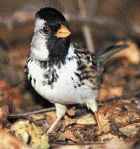
This one, for example, looks like it would be one of the more dominant individuals. Look at all that black! Man!

This one is a little scanty. He'd be more subordinate. Sorry, dude.
I gave the lecture today in my Ornithology class, on social behavior in birds. As I was preparing for the lecture, I found out something very interesting regarding social status and dominant behavior within species. Plumage has a lot to do with it. For example: the male Harris's Sparrow has black markings under it's chin and onto it's chest. Males with more defined black markings are dominant, and males with spotty markings are subordinate. And they fit into a pecking order with several levels based upon this. Dominant birds get first dibs on space, mates, and food. Subordinate individuals yield to the dominant ones, and everyone lives in peace. Now for the interesting story. There was a study done, where some subordinate Harris's Sparrows were taken, and their feathers under the chin and on the chest were dyed black so that they resembled a dominant individual. This is what happened to them: the actual dominant individuals started attacking them, because they represented a threat to their status. Instead of fighting back, which would have allowed these subordinate birds (who looked dominant) to climb in rank and actually become more dominant, they backed off becuase they don't have aggressive tendancies like dominant birds do. So it pretty much just confused them. "I've always been so good at yielding to the dominant birds. Why are they attacking me? Leave me alone!" I thought it was kind of a funny story.
This one, for example, looks like it would be one of the more dominant individuals. Look at all that black! Man!
This one is a little scanty. He'd be more subordinate. Sorry, dude.
Monday, May 02, 2005
Well, I'm dying for the last time in the Shakespeare Game (I mentioned it once a lont time ago) this semester. This class is just fun. I loved Shakespeare coming in, and so have appreciated the chance to read three plays with others who love Shakespeare, too.
Here's the final speech I posted:
What thou blushes at? Thine own shame. What makes thine knobby knees knock about? The sound of mine name.
Hamlet's words flow easier than mine own, and fit the time as well as any perfectly played melody.
Not a whit, we defy augury: there's a special
providence in the fall of a sparrow. If it be now,
'tis not to come; if it be not to come, it will be
now; if it be not now, yet it will come: the
readiness is all: since no man has aught of what he
leaves, what is't to leave betimes?
I determined to know thine name, which I now declare is John de Vere, 13th Earl of Oxford.
You are right in saying that I am.
But, with the Dane, I am resolved to rest in the arms of the Almighty God. Certainly, you do not believe that I can be shaken, or frightened, or alarmed at this my death? Or at you my killer?
No, for I know that there is a divinity that shapes our ends, rough-hew them how we will.
And here, at my end, I will not struggle against the Almighty's providence. Nor will I shy away from my heart's desire! Indeed, your cackling at my passing seems to be misplaced, and to be hidden both from the light of faith and reason. Hear the words of the Philosopher:
For I deem that the true disciple of philosophy is likely to be misunderstood by other men; they do not perceive that he is ever pursuing death and dying; and if this is true, why, having had the desire of death all his life long, should he repine at the arrival of that which he has been always pursuing and desiring?
No, I will not faint away from this my glorious entrance into the further life. The veil is lifting, soon I will behold a glorious light, to fill and pierce my soul eternally. For, unlike Socrates, I am entering into the Peace beyond time, the Tri-une God of Revelation:
That light doth so transform a man's whole bent
That never to another sight or thought
Would he surrender, with his own consent;
For everything the will has ever sought
Is gathered there, and there is every quest
Made perfect, which apart from it falls short.
You see, your act, though stemming from hate, works the mercy of the Lord upon my soul.
Yet, be warned the Providence of whom you are an instrument, and upon which I base my future hope is two edged. God dispenses Grace freely on those who beseech it, but it deals justice harshly on those who spurn this Grace!
And it will not be withheld forever, for now in my last moment, I take upon me the role of Margaret of Anjou, and speak prophecies regarding the failure of your low-born house. I can see in my mind's eye the fall of York from the crown, as Jesus once saw Satan fall from heaven. And my fellow Lancastrians, standing on Christ's own behalf for the true king of England, his political regent on this earth, are empowered to trample on you scorpion's and serpents. Such is your house! Such is your lowest (yet greatest): the ignoble Richard III is the very archetype of your morality! Therefore heed my words of caution and beware the ghosts of your past sins. The souls of those you've wronged will not be silent.
Nor will the God who sees the fall of his innocent sparrow.
As for the rest,
The rest is silence.
Silent, that is, except for this! In the style of Eliot, I give helpful Footnotes:
1. Hamlet, 5.2.
2. Luke 22:70 (I use the words of Jesus not to blaspheme, but to indicate that while they understand who I am, it does not follow that I am worthy of death)
3. Hamlet, 5.2.
4. Plato, Phaedo.
5. Dante, Paradiso, XIII. 100 - 106. trans. Sayers (these lines run roughly)
6. Luke 10:18, 19.
7. Hamlet, 5.2.
(Bubbs quotes don't really translate into Blogger: bold italics are the person accusing me, and italics are the footnoted quotes.)
Here's the final speech I posted:
What thou blushes at? Thine own shame. What makes thine knobby knees knock about? The sound of mine name.
Hamlet's words flow easier than mine own, and fit the time as well as any perfectly played melody.
Not a whit, we defy augury: there's a special
providence in the fall of a sparrow. If it be now,
'tis not to come; if it be not to come, it will be
now; if it be not now, yet it will come: the
readiness is all: since no man has aught of what he
leaves, what is't to leave betimes?
I determined to know thine name, which I now declare is John de Vere, 13th Earl of Oxford.
You are right in saying that I am.
But, with the Dane, I am resolved to rest in the arms of the Almighty God. Certainly, you do not believe that I can be shaken, or frightened, or alarmed at this my death? Or at you my killer?
No, for I know that there is a divinity that shapes our ends, rough-hew them how we will.
And here, at my end, I will not struggle against the Almighty's providence. Nor will I shy away from my heart's desire! Indeed, your cackling at my passing seems to be misplaced, and to be hidden both from the light of faith and reason. Hear the words of the Philosopher:
For I deem that the true disciple of philosophy is likely to be misunderstood by other men; they do not perceive that he is ever pursuing death and dying; and if this is true, why, having had the desire of death all his life long, should he repine at the arrival of that which he has been always pursuing and desiring?
No, I will not faint away from this my glorious entrance into the further life. The veil is lifting, soon I will behold a glorious light, to fill and pierce my soul eternally. For, unlike Socrates, I am entering into the Peace beyond time, the Tri-une God of Revelation:
That light doth so transform a man's whole bent
That never to another sight or thought
Would he surrender, with his own consent;
For everything the will has ever sought
Is gathered there, and there is every quest
Made perfect, which apart from it falls short.
You see, your act, though stemming from hate, works the mercy of the Lord upon my soul.
Yet, be warned the Providence of whom you are an instrument, and upon which I base my future hope is two edged. God dispenses Grace freely on those who beseech it, but it deals justice harshly on those who spurn this Grace!
And it will not be withheld forever, for now in my last moment, I take upon me the role of Margaret of Anjou, and speak prophecies regarding the failure of your low-born house. I can see in my mind's eye the fall of York from the crown, as Jesus once saw Satan fall from heaven. And my fellow Lancastrians, standing on Christ's own behalf for the true king of England, his political regent on this earth, are empowered to trample on you scorpion's and serpents. Such is your house! Such is your lowest (yet greatest): the ignoble Richard III is the very archetype of your morality! Therefore heed my words of caution and beware the ghosts of your past sins. The souls of those you've wronged will not be silent.
Nor will the God who sees the fall of his innocent sparrow.
As for the rest,
The rest is silence.
Silent, that is, except for this! In the style of Eliot, I give helpful Footnotes:
1. Hamlet, 5.2.
2. Luke 22:70 (I use the words of Jesus not to blaspheme, but to indicate that while they understand who I am, it does not follow that I am worthy of death)
3. Hamlet, 5.2.
4. Plato, Phaedo.
5. Dante, Paradiso, XIII. 100 - 106. trans. Sayers (these lines run roughly)
6. Luke 10:18, 19.
7. Hamlet, 5.2.
(Bubbs quotes don't really translate into Blogger: bold italics are the person accusing me, and italics are the footnoted quotes.)
Subscribe to:
Posts (Atom)