The following is an annotated list of all the bird species we saw on our trip to Texas. The taxonomic order is taken from A Checklist of Texas Birds (7th edition). Lifers are in bold. The annotations are based on our daily check-lists - on which we marked where we saw each bird recorded - and my general impression of how many birds we saw at those locations.
1. Black-bellied Whistling Duck (common in most bodies of water)
2. Fulvous Whistling Duck (Estero Llano and Laguna Atascosa)
3. Muscovy Duck (wild birds only seen at Salineno, domestic escapees were common in urban resacas)
4. Mallard (Two Mexican birds at Estero Llano, perhaps at Salineno; domestic birds at a resaca in Brownsviille were our only green-headed Anas of the trip)
5. Mottled Duck (A pair of birds at the South Padre Island Convention Center boardwalk were our only representatives of this species)
6. Blue-winged Teal (Common throughout valley)
7. Northern Shoveler (Uncommon in bodies of water throughout valley)
8. Lesser Scaup (One male was diving at Estero Llano Grande State Park)
9. Masked Duck (Two basic plumaged birds at Alligator Pond at Laguna Atascosa NWR)
10. Ruddy Duck (Laguna Atascosa)
11. Plain Chachalaca (plentiful in lower valley sanctuaries)
12. Wild Turkey (one bird at Laguna Atascosa feeders)
13. Northern Bobwhite (Falcon State Park)
14. Common Loon (one probable loon in basic plumage just off the causeway near Port Isabella)
15. Least Grebe (fairly common in preserves in the lower valley)
16. Pied-billed Grebe (common throughout the valley)
17. American White Pelican (migrating flocks at Estero Llano Grande and Laguna Atascosa)
18. Brown Pelican (common around the Laguna Madre)
19. Neotropic Cormorant (Santa Ana NWR and Fort Brown resaca)
20. Double-crested Cormorant (Salineno, and Fort Brown resaca)
21. Anhinga (Bentsen and Santa Ana NWR)
22. Least Bittern (SPI Convention Center boardwalk)
23. Great Blue Heron (We only saw these from Brownsville to the coast or so, and on the coast itself)
24. Great Egret (Common throughout)
25. Snowy Egret (Very uncommon - SPI + Santa Ana)
26. Little Blue Heron (on bodies of water throughout)
27. Tricolored Heron (on bodies of water throughout)
28. Reddish Egret (on SPI and near coast)
29. Cattle Egret (common throughout)
30. Green Heron (uncommon throughout, even in migrant traps away from water on SPI)
31. Yellow-crowned Night Heron (SPI and Frontera)
32. White Ibis (common around water throughout the lower valley)
33. White-faced Ibis (less common than White Ibis - Estero Llano and Laguna Atascosa)
34. Roseate Spoonbill (We only saw these in the vacinity of Laguna Atascosa, but apparently uncommon throughout the valley, especially near the coast)
35. Black Vulture (Falcon Dam and vacinity and Laguna Atascosa hosted our only representatives of this species)
36. Turkey Vulture (Fairly common throughout)
37. Osprey (Salineno, Bentsen, SPI)
38. White-tailed Kite (Bentsen and Sabal Palm)
39. Mississippi Kite (migrants over Bentsen)
40. Cooper's Hawk (a soaring bird at Laguna Atascosa)
41. Harris's Hawk (the most common resident raptor - perched on roadsides sparingly throughout)
42. Red-shouldered Hawk (in riparian areas throughout)
43. Broad-winged Hawk (hundreds of migrants over Bentsen, Santa Ana and Quinta Mazatlan)
44. Swainson's Hawk (migrants over Bentsen and Santa Ana, as well as along roadsides in that general area)
45. White-tailed Hawk (one bird along the freeway to Port Isabella from Brownsville)
46. Crested Caracara (most common around Laguna Atascosa and Falcon area)
47. American Kestrel (a few birds along the freeway near Zapata)
48. Aplomado Falcon (a non-countable bird at Laguna Atascosa)
49. Clapper Rail (along boardwalk at Convention Center)
50. Sora (at Laguna Atascosa and Convention Center boardwalk)
51. Common Moorhen (common throughout)
52. American Coot (common throughout)
53. Black-bellied Plover (coastal mud-flats)
54. American Golden-Plover (two were just off the boardwalk at SPI Convention Center)
55. Snowy Plover (A few were on the beach just north of the SPI Convention Center)
56. Wilson's Plover (off the boardwalk at SPI Convention Center)
57. Semipalmated Plover (mud flats north of the boardwalk area, off the Convention Center deck)
58. Killdeer (common throughout)
59. Black-necked Stilt (Santa Ana, Estero Llano and SPI)
60. American Avocet (SPI and Laguna Atascosa)
61. Greater Yellowlegs
62. Lesser Yellowlegs (Lesser Yellowlegs appeared to be more common than Greater, and a few were found in all congregations of shorebirds we encountered.)
63. Solitary Sandpiper (Our first Solitary Sandpipers ever were at Santa Ana)
64. Willet (Willets were common near the coast)
65. Spotted Sandpiper (Uncommon - Estero Llano had one or two)
66. Long-billed Curlew (Near the coast)
67. Ruddy Turnstone (Fairly common on mudflats near the coast)
68. Sanderling (Uncommon near the coast)
69. Semipalmated Sandpiper (Most peeps we encountered were Least. Only one clear Semipalmated Sandpiper - off the boardwalk at SPI)
70. Western Sandpiper (A few at SPI)
71. Least Sandpiper (Common throughout valley)
72. Pectoral Sandpiper (SPI)
73. Dunlin (One of the most common sandpipers at SPI)
74. Stilt Sandpiper (Our only Stilt Sandpipers were with Dowitchers at Santa Ana)
75. Short-billed Dowitcher
76. Long-billed Dowitcher (Dowitchers were in every group of shorebirds we encountered. We didn't bother identifying them all, but we definitely had both at SPI)
77. Laughing Gull (Common, especially near the coast, but we even saw some near Falcon Dam)
78. Franklin's Gull (Uncommon as a migrant on SPI - we saw one with Laughing Gulls and a flock flew by off the boardwalk near the Convention Center)
79. Ring-billed Gull (One second year bird in flock of Laughing Gulls near the convention center)
80. Herring Gull (One immature bird dwarfing the Laughing Gulls near the convention center)
81. Gull-billed Tern (Quite common, even a few miles inland)
82. Caspian Tern (SPI)
83. Royal Tern (SPI - apparently more common than Caspian where we were)
84. Sandwich Tern (SPI - apparently rather uncommon - only a few birds on the Laguna Madre)
85. Forster's Tern (Laguna Atascosa)
86. Least Tern (Estero Llano Grande)
87. Black Skimmer (Around SPI)
88. Rock Pigeon (common in urban areas)
89. Red-billed Pigeon (only at Salineno)
90. Eurasian Collared Dove (a few on telephone wires in rural areas, and one seen well at the Sheepshead Lot in SPI)
91. White-winged Dove (Ubiquitous throughout the valley)
92. Mourning Dove (Common throughout)
93. Inca Dove (Common throughout)
94. Common Ground Dove (Uncommon throughout the valley: we met a fellow who was having trouble finding them, but we didn't seem to. We had one in urban McAllen, several at Bentsen, and an incredible bright male at Salineno. Inca Doves did appear to be more common, however.)
95. White-tipped Dove (Common in preserves throughout valley, though easiest to see around feeders)
96. Green Parakeet (Fort Brown)
97. Red-crowned Parrot (Fort Brown - three in the aggregation of Green Parakeets)
98. Greater Roadrunner (Uncommon throughout - we saw them mostly upriver)
99. Groove-billed Ani (A small family group of at least three was around the hawk tower at Bentsen)
100. Eastern Screech-Owl (A single bird sticking its head out of a nest box at Salineno - the birds in southern Texas are of the McCall's race)
101. Lesser Nighthawk (A flock of these were swirling around the shore of the river at Salineno before dawn)
102. Common Pauraque (A single day-roosting bird at Estero Llano Grande)
103. Chimney Swift (Santa Ana and Frontera had some birds overhead)
104. Buff-bellied Hummingbird (Common in the valley and at Laguna Atascosa - we didn't see any up around Falcon Dam, and we didn't see any on the island)
105. Ruby-throated Hummingbird (Lots of Archilocus hummingbirds migrating throughout south Texas - probably a little less than half were males, and of the males, all but one were Ruby-throated)
106. Black-chinned Hummingbird (A single male briefly visited a feeder at Estero Llano Grande's visitor center)
107. Ringed Kingfisher (Bentsen and Salineno)
108. Green Kingfisher (Santa Ana and Salineno)
109. Golden-fronted Woodpecker (Common throughout the valley)
110. Ladder-backed Woodpecker (Probably as common as Golden-fronted, though a little less conspicuous)
111. Eastern Wood Pewee (We saw a lot of Wood Pewees at the migrant traps in SPI. The law of percentages alone dictates that one of them, at least, was an Eastern Wood Pewee given that Western Wood Pewees are rare there. None of them vocalized, but one of the birds we saw was very pale and carried its tail at the same angle as its body - a posture more typical of Eastern Wood Pewees than of Western Wood Pewees. So, we're counting it as our life Eastern Wood Pewee.)
112. Least Flycatcher (Our only empid of the trip - perched in a tree near the parking lot at Frontera Audubon. Of the likely species present in south Texas during the period of our trip, this bird's short primary projection, round head and short bill best fit a Least Flycatcher.)
113. Ash-throated Flycatcher (Bentsen and Falcon had this species)
114. Great-crested Flycatcher (uncommon in the eastern valley as a migrant)
115. Brown-crested Flycatcher (uncommon in the eastern valley as a migrant - I had a great look at Frontera of one perched in the same binocular view as a Great-crested Flycatcher. Myiarchus flycatchers in general were quite common during our trip, and we didn't identify all of them to species.)
116. Great Kiskadee (Quite common throughout the valley. I even saw one in our hotel parking lot in Brownsville, and one was in the mangroves near the Convention Center in SPI.)
117. Tropical Kingbird (We had one group of three at the lighthouse in Port Isabella, and happened to hear another twittering on the UT Brownsville campus as we looked for Green Parakeets.)
118. Couch's Kingbird (Very common everywhere.)
119. Western Kingbird (Our first kingbird in Texas turned out to be a Western, and we had a few others - one at Salineno and one in SPI.)
120. Scissor-tailed Flycatcher (We didn't see any of these until a pair showed up at Santa Ana on our third day. They were very common on telephone wires along the highway to Zapata, and then uncommon again when we got to Brownsville and its surrounding areas.)
121. Loggerhead Shrike (A few of these birds were on telephone wires on the highways around Zapata, and one was near Laguna Atascosa.)
122. White-eyed Vireo (We only saw one of these, at Santa Ana, and we saw it very well as it sang from exposed branches only a few feet from us. However, despite hearing its song other times, we never got another glimpse of one.)
123. Blue-headed Vireo (Sabal Palm and SPI)
124. Warbling Vireo (Santa Ana and Frontera)
125. Red-eyed Vireo (Frontera)
126. Green Jay (Common in preserves)
127. Chihuahuan Raven (Some were along the roadside around the Falcon Dam, and some were down around Sabal Palm.)
128. Purple Martin (We noticed these high above us in McAllen our first day, but not again.)
129. Northern Rough-winged Swallow (These were common throughout our trip.)
130. Cliff Swallow (Because of the height and speed at which many of the swallows we saw were foraging, we weren't able to definitively identify most of the ones with pale rumps. We saw one Cliff Swallow that swooped in low and close to us at Santa Ana.)
131. Cave Swallow (The cause of our hestancy with Cliff Swallow identification. We saw a few definite birds near a bridge on the way to the Falcon Dam.)
132. Barn Swallow (Easy to identify, these were common throughout our trip.)
133. Black-crested Titmouse (Uncommon in appropriate habitat throughout.)
134. Carolina Wren (Common throughout)
135. Bewick's Wren (We found one along the fence in the preserve at Salineno.)
136. House Wren (We had several probable House Wrens hide from us throughout the trip, but had great looks at one migrant at the convention center.)
137. Sedge Wren (Convention Center boardwalk)
138. Marsh Wren (We had brief looks at one off the boardwalk, where they were very vocal. Eastern Marsh Wrens may be a distinct species from the western birds we have in southern California)
139. Ruby-crowned Kinglet (One at Bentsen)
140. Blue-gray Gnatcatcher (Santa Ana)
141. Veery (SPI and Laguna Atascosa)
142. Swainson's Thrush (Our first Olive-backed individual: at SPI)
143. Clay-colored Thrush (Robin) (Santa Ana and Frontera)
144. Gray Catbird (Frontera)
145. Northern Mockingbird (Surely, Texas's state bird is well chosen. There are seemingly millions of them.)
146. Long-billed Thrasher (Common and surprisingly easy to see in suitable habitat)
147. Curve-billed Thrasher (Slightly distinguishable eastern subspecies new to us - Quinta Mazatlan and Falcon)
148. European Starling (Common throughout)
149. Tennessee Warbler (One of the most common warblers migrating through)
150. Nashville Warbler (The other most common warbler migrating through. Disjunct nominate subspecies, but it looks a heck of a lot like the ones we have out here.)
151. Northern Parula (A few - Bentsen, Santa Ana, Sabal Palm, Laguna Atascosa and Frontera)
152. Yellow Warbler (One male at Laguna Atascosa)
153. Chestnut-sided Warbler (Males in SPI; an incredible bird in spring plumage)
154. Yellow-rumped Warbler (We had three or four in SPI, most Myrtles but one was a brilliant male Audubon's. That was a nice touch of home.)
155. Black-throated Green Warbler (Santa Ana and SPI)
156. Yellow-throated Warbler (One at Santa Ana; my favorite new warbler for the trip)
157. Palm Warbler (One pale western bird in SPI)
158. Blackpoll Warbler (both sexes in spring condition in SPI)
159. Black-and-White Warbler (Santa Ana, Sabal Palm, Laguna Atascosa and Frontera)
160. American Redstart (Both sexes in SPI)
161. Ovenbird (A single bird seen quite well at Frontera. An odd, but endearing little warbler)
162. Northern Waterthrush (Saw quite a few of these in SPI.)
163. Louisiana Waterthrush (Someone else helped us identify one of these in the grass near the convention center in SPI.)
164. Common Yellowthroat (Heard or seen throughout valley)
165. Yellow-breasted Chat (Santa Ana, SPI and Frontera)
166. Summer Tanager (A migrant pair at Santa Ana were our only pirangas for the trip.)
167. Olive Sparrow (Common throughout the valley)
168. Lark Sparrow (Uncommon in the valley, we saw some at Bentsen)
169. Savannah Sparrow (Uncommon migrant in the valley, and at SPI every day we visited)
170. Lincoln's Sparrow (Uncommon in the valley, but common in SPI migrant traps)
171. White-throated Sparrow (Two, tan-striped and white-striped, at feeders at Laguna Atascosa)
172. Crimson-collared Grosbeak (Single female at Frontera)
173. Northern Cardinal (Common in woody areas throughout the valley)
174. Pyrrhuloxia (Falcon State Park)
175. Rose-breasted Grosbeak (SPI and Laguna Atascosa)
176. Blue Grosbeak (A female at Laguna Atascosa)
177. Indigo Bunting (Common throughout valley)
178. Varied Bunting (A single male at Salineno)
179. Painted Bunting (Males at Bentsen, Santa Ana, and Laguna Atascosa)
180. Dickcissel (A big flock in the mangroves at SPI Convention Center, and then a single bird the next morning in the Convention Center garden.)
181. Red-winged Blackbird (Very common everywhere)
182. Eastern Meadowlark (Common in coastal prairie habitat)
183. Great-tailed Grackle (Very common everywhere)
184. Bronzed Cowbird (Uncommon throughout, except where concentrated around feeders)
185. Brown-headed Cowbird (Uncommon throughout)
186. Orchard Oriole (Common migrant in SPI; also at Laguna Atascosa)
187. Hooded Oriole (Orange-ish eastern subspecies: Fairly common, seemed more common up river, but we also saw them at Bentsen.)
188. Altamira Oriole (Most common at Bentsen, but also at Salineno, Santa Ana and Laguna Atascosa)
189. Audubon's Oriole (Our only Audubon's Oriole was at the Sabal Palm feeders. We looked pretty hard at Salineno, but came up empty. Someone else we talked to later said they found them there a few days later, though.)
190. Baltimore Oriole (Found in SPI and Laguna Atascosa)
191. House Finch (A single female at the pond in Zapata was south of its normal range.)
192. Lesser Goldfinch (Zapata and Frontera - at Frontera we found a beautiful black-backed male.)
193. House Sparrow (Common everywhere, of course)
That's not a bad list since we were focusing on finding new birds, and not building a long trip list. Of our 193 birds, seventy were new, which is more than a third of the birds that we saw on the trip. With such a nice collection of birds, we don't really have anything to complain about. We did miss a few birds that are specialties of the area for the United States: Hook-billed Kite, Ferruginous Pygmy-Owl and Tropical Parula. I feel like the Masked Ducks and Crimson-collared Grosbeaks make up for that, though. I was also hoping for some more migrant warblers, especially Swainson's, but that's kind of outside of our control.
Sunday, May 10, 2009

Monday, May 04, 2009
Last Day in Texas
It's amazing how blogging about a trip drags out so long after the trip is over!
Anyway, our last day in Texas was awesome. Our flight out of McAllen was at about 6:00 pm, so we figured we had a good portion of the day available for looking at some birds, and we took full advantage of the opportunity.
Our first stop took us right back to South Padre Island. After all, you never know what might have flown in overnight. It turned out that not too much had, but we still found some new birds out by the boardwalk. Still, one can't complain about Tennessee Warblers and Baltimore Orioles!
The tide was lower on this trip out on the boardwalk, so there were a few more shorebirds around. One of them proved to be a stubby-billed Semipalmated Sandpiper, which was yet another new bird. As we walked back to the convention center, we paused to see if we could catch a glimpse of one of the Sedge Wrens that was singing. A little bird flicking through some nearby sedges proved to be just what we were looking for, eventually popping right up and giving great views as it sang.
From there, we made a couple of more trips around the migrant traps. Sheepshead Lot, further south on the island, had some Wood-Pewees, but not much else, so we headed off in the direction of the airport. Before we got there, however, we took a detour to Frontera Audubon Thicket in Weslaco. This is a small private preserve managed by the Audubon society of the area. It hosted most of the regular specialties, but it also had a couple of rare birds hanging around from the winter - a Crimson-collared Grosbeak and a Blue Bunting. Both were females, and both had been notoriously difficult to see during the time we were there. We didn't anticipate actually seeing them, but there were also reports of some nice migrants that might be a little different than the ones we'd seen on the island.
So, we dropped by in hopes of a few migrants and with the small possibility of a mega-rarity. It turned out we got some new migrants, and we got one of the rarities, so it was better than we could have reasonably hoped! One of our first birds out of the car turned out to be a migrant Least Flycatcher, a new bird. A few warblers were gleaning in the nearby trees, and an amazingly cooperative Olive Sparrow hopped out into the parking lot.
We had our lunch first thing after that, admiring Buff-bellied Hummingbirds as they came to nearby feeders, and our last Golden-fronted Woodpeckers as they busied themselves in overhanging branches. After a lunch, we took a stroll around the grounds, where we found one of our biggest warbler flocks of the whole trip. Nothing new in the bunch we could find, though, just 30 or so Nashville Warblers, Black and Whites, and a few Northern Parulas.
After walking all the trails, almost getting lost, and finding our way back to the feeders, we settled in to wait and see what would come in for a drink or dip in a little water feature there. Some people we'd talked to earlier that day recommended spending an hour at the stream as a great way to see a wide variety of warblers. While we waited, we sat and talked to bird photographer who'd flown in from Tustin Ranch to look for the Grosbeak. It's a small world, after all. Suddenly, an olive green streak darted over the water and behind a nearby fence. I goggled at Libby and our new acquaintance. "Could that have been...?"
But neither Libby nor Monte (from Tustin Ranch) had gotten as good a look at it as I. I decided to indulge my gut feeling, and Libby and I got up and walked around the fence into the parking lot area. Again, a large bird flushed, up and over another fence into the thicket. It sure looked a dull green color to me, so we backtracked, and went through another gate to check "the spot" where the Crimson-collared Grosbeak was most often seen, which was in the direction the bird had headed. Standing in the spot, and gazing into the dense vegetation, we simultaneously caught our breath. There it was! Right out in the open, easily visible!
I yelped as quietly as I could to get Monte's attention, and he came scrambling over with a camera. Unfortunately, as he came up, it started slipping down the branches into denser leaves. He got a glimpse of it, but I don't know if he got a picture at the time. He did get a picture, though, which you can view here.
When another group of birders arrived a little bit later, and they also got some brief partial looks at the bird while we were there, but nobody got as lucky as we did while we were there. Sometimes fortune smiles upon you. They seemed to know well what they were doing, though, as they found a few other new birds for us, like an Ovenbird, Red-eyed Vireo, and a Gray Catbird. We took a few more turns around the orchard area looking for the Blue Bunting, but we never found it and pretty soon it was time to head home.
McAllen's airport is really small and I like that. There were no lines for security, and there are only half a dozen gates in the same area. Dallas/Fort Worth, on the other hand, is huge, and we spent three hours contemplating its vastness before taking a red-eye to L.A., picking up our car a little before 1:00 in the morning, and hitting the hay around 1:30 am so I could make it to work at 8:00 in the morning.
Pictures from our last day can be found here: Texas Day Seven.
New birds for the day:
1. Least Bittern
2. Least Flycatcher
3. Semipalmated Sandpiper
4. Red-eyed Vireo
5. Sedge Wren
6. Gray Catbird
7. Ovenbird
8. Crimson-collared Grosbeak
Anyway, our last day in Texas was awesome. Our flight out of McAllen was at about 6:00 pm, so we figured we had a good portion of the day available for looking at some birds, and we took full advantage of the opportunity.
Our first stop took us right back to South Padre Island. After all, you never know what might have flown in overnight. It turned out that not too much had, but we still found some new birds out by the boardwalk. Still, one can't complain about Tennessee Warblers and Baltimore Orioles!
After enjoying the migrants, we headed for the boardwalk. The mangroves there are supposed to host Seaside Sparrows, and I was hoping that one would pop up for us. No luck, but as we walked out into the mangroves, we were stopped short in surprise by a teeny tiny little Least Bittern sitting as still as it could to avoid detection. That was a neat find, and a lifer, to boot! This is the smallest of our herons, and cute as a button.

The tide was lower on this trip out on the boardwalk, so there were a few more shorebirds around. One of them proved to be a stubby-billed Semipalmated Sandpiper, which was yet another new bird. As we walked back to the convention center, we paused to see if we could catch a glimpse of one of the Sedge Wrens that was singing. A little bird flicking through some nearby sedges proved to be just what we were looking for, eventually popping right up and giving great views as it sang.
From there, we made a couple of more trips around the migrant traps. Sheepshead Lot, further south on the island, had some Wood-Pewees, but not much else, so we headed off in the direction of the airport. Before we got there, however, we took a detour to Frontera Audubon Thicket in Weslaco. This is a small private preserve managed by the Audubon society of the area. It hosted most of the regular specialties, but it also had a couple of rare birds hanging around from the winter - a Crimson-collared Grosbeak and a Blue Bunting. Both were females, and both had been notoriously difficult to see during the time we were there. We didn't anticipate actually seeing them, but there were also reports of some nice migrants that might be a little different than the ones we'd seen on the island.
So, we dropped by in hopes of a few migrants and with the small possibility of a mega-rarity. It turned out we got some new migrants, and we got one of the rarities, so it was better than we could have reasonably hoped! One of our first birds out of the car turned out to be a migrant Least Flycatcher, a new bird. A few warblers were gleaning in the nearby trees, and an amazingly cooperative Olive Sparrow hopped out into the parking lot.

We had our lunch first thing after that, admiring Buff-bellied Hummingbirds as they came to nearby feeders, and our last Golden-fronted Woodpeckers as they busied themselves in overhanging branches. After a lunch, we took a stroll around the grounds, where we found one of our biggest warbler flocks of the whole trip. Nothing new in the bunch we could find, though, just 30 or so Nashville Warblers, Black and Whites, and a few Northern Parulas.
After walking all the trails, almost getting lost, and finding our way back to the feeders, we settled in to wait and see what would come in for a drink or dip in a little water feature there. Some people we'd talked to earlier that day recommended spending an hour at the stream as a great way to see a wide variety of warblers. While we waited, we sat and talked to bird photographer who'd flown in from Tustin Ranch to look for the Grosbeak. It's a small world, after all. Suddenly, an olive green streak darted over the water and behind a nearby fence. I goggled at Libby and our new acquaintance. "Could that have been...?"
But neither Libby nor Monte (from Tustin Ranch) had gotten as good a look at it as I. I decided to indulge my gut feeling, and Libby and I got up and walked around the fence into the parking lot area. Again, a large bird flushed, up and over another fence into the thicket. It sure looked a dull green color to me, so we backtracked, and went through another gate to check "the spot" where the Crimson-collared Grosbeak was most often seen, which was in the direction the bird had headed. Standing in the spot, and gazing into the dense vegetation, we simultaneously caught our breath. There it was! Right out in the open, easily visible!
I yelped as quietly as I could to get Monte's attention, and he came scrambling over with a camera. Unfortunately, as he came up, it started slipping down the branches into denser leaves. He got a glimpse of it, but I don't know if he got a picture at the time. He did get a picture, though, which you can view here.
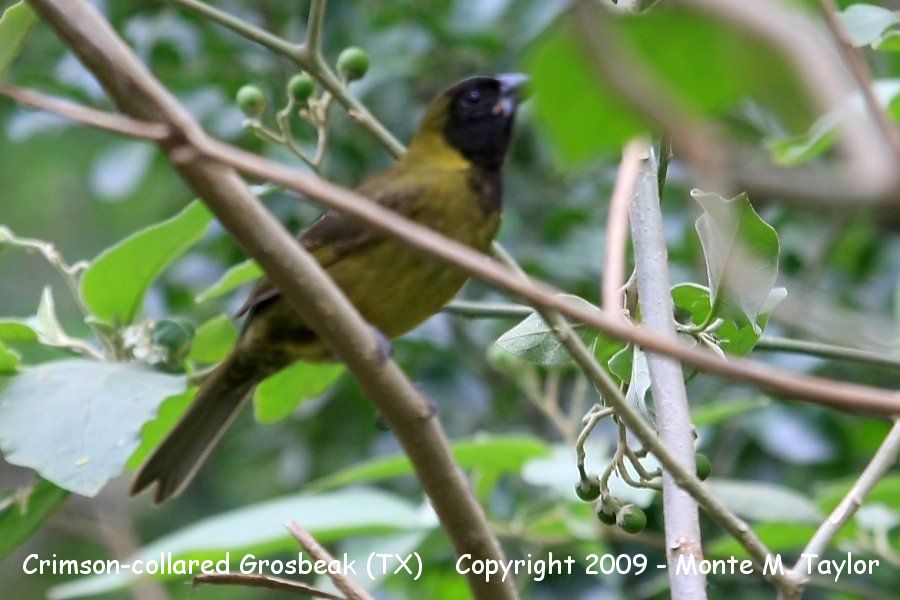
When another group of birders arrived a little bit later, and they also got some brief partial looks at the bird while we were there, but nobody got as lucky as we did while we were there. Sometimes fortune smiles upon you. They seemed to know well what they were doing, though, as they found a few other new birds for us, like an Ovenbird, Red-eyed Vireo, and a Gray Catbird. We took a few more turns around the orchard area looking for the Blue Bunting, but we never found it and pretty soon it was time to head home.
McAllen's airport is really small and I like that. There were no lines for security, and there are only half a dozen gates in the same area. Dallas/Fort Worth, on the other hand, is huge, and we spent three hours contemplating its vastness before taking a red-eye to L.A., picking up our car a little before 1:00 in the morning, and hitting the hay around 1:30 am so I could make it to work at 8:00 in the morning.
Pictures from our last day can be found here: Texas Day Seven.
New birds for the day:
1. Least Bittern
2. Least Flycatcher
3. Semipalmated Sandpiper
4. Red-eyed Vireo
5. Sedge Wren
6. Gray Catbird
7. Ovenbird
8. Crimson-collared Grosbeak
Friday, May 01, 2009
Don't Wake Me; I Plan On Sleeping In
The other night I had the strangest dream. I dreamed about an imaginary bird. A Hummingbird House Sparrow. Or a House Sparrow Hummingbird. Its color and build were that of a House Sparrow, but it was small and flew like a Hummingbird. Jonathan drew a picture of it for me:
 I dreamed that this Hummingbird House Sparrow was dive-bombing something defenseless, like a baby or maybe a puppy. Jonathan and I felt compelled to come to the aid of this defenseless creature, and we tried many ways of stopping the Hummingbird House Sparrow. We tried to catch it, but it evaded our grasp. Then we tried hitting it with a stick, but it successfully dodged each swing. Finally, we tried our fists. It turned out that, with careful aim, we could manage a good, square punch each time it came in for another attack. This it did often. Our blows did not seem to injure the Hummingbird House Sparrow at all. It kept coming back. But we were able to keep it from harming the baby/puppy, so we were successful.
I had no memory of the dream when I first awoke. But as I was walking from the car to my classroom a couple of hours later, I saw a House Sparrow hopping in the courtyard, and I chuckled as I recalled the Hummingbird House Sparrow I had punched in my dreams.
 I dreamed that this Hummingbird House Sparrow was dive-bombing something defenseless, like a baby or maybe a puppy. Jonathan and I felt compelled to come to the aid of this defenseless creature, and we tried many ways of stopping the Hummingbird House Sparrow. We tried to catch it, but it evaded our grasp. Then we tried hitting it with a stick, but it successfully dodged each swing. Finally, we tried our fists. It turned out that, with careful aim, we could manage a good, square punch each time it came in for another attack. This it did often. Our blows did not seem to injure the Hummingbird House Sparrow at all. It kept coming back. But we were able to keep it from harming the baby/puppy, so we were successful.
I had no memory of the dream when I first awoke. But as I was walking from the car to my classroom a couple of hours later, I saw a House Sparrow hopping in the courtyard, and I chuckled as I recalled the Hummingbird House Sparrow I had punched in my dreams.
Subscribe to:
Posts (Atom)