Anyway, our last day in Texas was awesome. Our flight out of McAllen was at about 6:00 pm, so we figured we had a good portion of the day available for looking at some birds, and we took full advantage of the opportunity.
Our first stop took us right back to South Padre Island. After all, you never know what might have flown in overnight. It turned out that not too much had, but we still found some new birds out by the boardwalk. Still, one can't complain about Tennessee Warblers and Baltimore Orioles!
After enjoying the migrants, we headed for the boardwalk. The mangroves there are supposed to host Seaside Sparrows, and I was hoping that one would pop up for us. No luck, but as we walked out into the mangroves, we were stopped short in surprise by a teeny tiny little Least Bittern sitting as still as it could to avoid detection. That was a neat find, and a lifer, to boot! This is the smallest of our herons, and cute as a button.

The tide was lower on this trip out on the boardwalk, so there were a few more shorebirds around. One of them proved to be a stubby-billed Semipalmated Sandpiper, which was yet another new bird. As we walked back to the convention center, we paused to see if we could catch a glimpse of one of the Sedge Wrens that was singing. A little bird flicking through some nearby sedges proved to be just what we were looking for, eventually popping right up and giving great views as it sang.
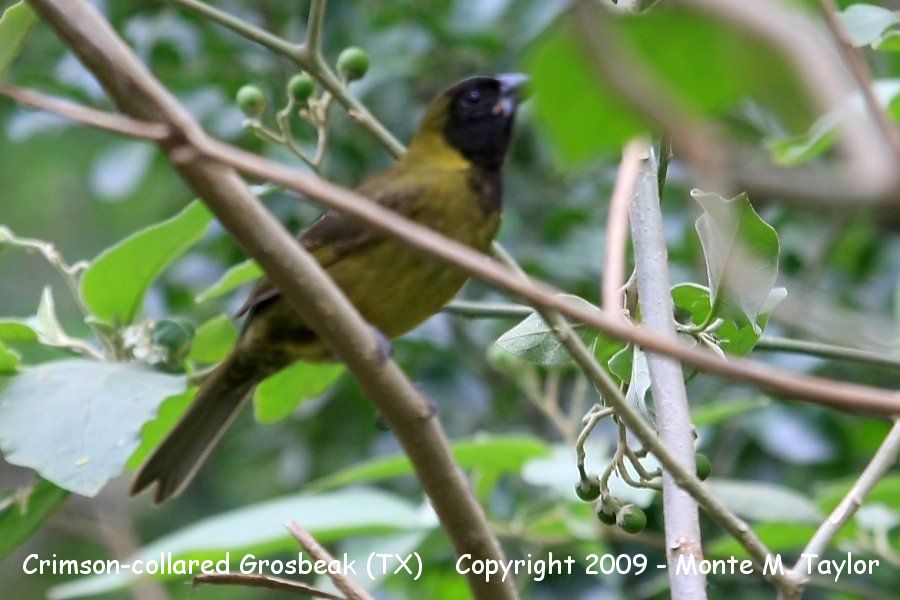
From there, we made a couple of more trips around the migrant traps. Sheepshead Lot, further south on the island, had some Wood-Pewees, but not much else, so we headed off in the direction of the airport. Before we got there, however, we took a detour to Frontera Audubon Thicket in Weslaco. This is a small private preserve managed by the Audubon society of the area. It hosted most of the regular specialties, but it also had a couple of rare birds hanging around from the winter - a Crimson-collared Grosbeak and a Blue Bunting. Both were females, and both had been notoriously difficult to see during the time we were there. We didn't anticipate actually seeing them, but there were also reports of some nice migrants that might be a little different than the ones we'd seen on the island.
So, we dropped by in hopes of a few migrants and with the small possibility of a mega-rarity. It turned out we got some new migrants, and we got one of the rarities, so it was better than we could have reasonably hoped! One of our first birds out of the car turned out to be a migrant Least Flycatcher, a new bird. A few warblers were gleaning in the nearby trees, and an amazingly cooperative Olive Sparrow hopped out into the parking lot.

We had our lunch first thing after that, admiring Buff-bellied Hummingbirds as they came to nearby feeders, and our last Golden-fronted Woodpeckers as they busied themselves in overhanging branches. After a lunch, we took a stroll around the grounds, where we found one of our biggest warbler flocks of the whole trip. Nothing new in the bunch we could find, though, just 30 or so Nashville Warblers, Black and Whites, and a few Northern Parulas.
After walking all the trails, almost getting lost, and finding our way back to the feeders, we settled in to wait and see what would come in for a drink or dip in a little water feature there. Some people we'd talked to earlier that day recommended spending an hour at the stream as a great way to see a wide variety of warblers. While we waited, we sat and talked to bird photographer who'd flown in from Tustin Ranch to look for the Grosbeak. It's a small world, after all. Suddenly, an olive green streak darted over the water and behind a nearby fence. I goggled at Libby and our new acquaintance. "Could that have been...?"
But neither Libby nor Monte (from Tustin Ranch) had gotten as good a look at it as I. I decided to indulge my gut feeling, and Libby and I got up and walked around the fence into the parking lot area. Again, a large bird flushed, up and over another fence into the thicket. It sure looked a dull green color to me, so we backtracked, and went through another gate to check "the spot" where the Crimson-collared Grosbeak was most often seen, which was in the direction the bird had headed. Standing in the spot, and gazing into the dense vegetation, we simultaneously caught our breath. There it was! Right out in the open, easily visible!
I yelped as quietly as I could to get Monte's attention, and he came scrambling over with a camera. Unfortunately, as he came up, it started slipping down the branches into denser leaves. He got a glimpse of it, but I don't know if he got a picture at the time. He did get a picture, though, which you can view here.
When another group of birders arrived a little bit later, and they also got some brief partial looks at the bird while we were there, but nobody got as lucky as we did while we were there. Sometimes fortune smiles upon you. They seemed to know well what they were doing, though, as they found a few other new birds for us, like an Ovenbird, Red-eyed Vireo, and a Gray Catbird. We took a few more turns around the orchard area looking for the Blue Bunting, but we never found it and pretty soon it was time to head home.
McAllen's airport is really small and I like that. There were no lines for security, and there are only half a dozen gates in the same area. Dallas/Fort Worth, on the other hand, is huge, and we spent three hours contemplating its vastness before taking a red-eye to L.A., picking up our car a little before 1:00 in the morning, and hitting the hay around 1:30 am so I could make it to work at 8:00 in the morning.
Pictures from our last day can be found here: Texas Day Seven.
New birds for the day:
1. Least Bittern
2. Least Flycatcher
3. Semipalmated Sandpiper
4. Red-eyed Vireo
5. Sedge Wren
6. Gray Catbird
7. Ovenbird
8. Crimson-collared Grosbeak

No comments:
Post a Comment