Showing posts with label film notes. Show all posts

Thursday, January 10, 2013

Movie Notes: A Matter of Life and Death

A Matter of Life and Death (1946)
Directors: Powell and Pressburger

This was an interesting film, and I mean that in the very best sense.

The movie's plot, in a nutshell, is that the British pilot of a WWII Lancaster survives, against all odds, his fall from his shot-up plane over the coast of England without a parachute.  Afterward, he meets the last person to whom he had spoken, an American radio operator with whom he falls in love, and Death -- in the form of an effete French gentleman who attempts to convince him to die.  The movie's plot travels forward in parallel: a technicolor production on earth wherein a neuroscientist and his new found love work to save his life, and a black-and-white drama in heaven where he appeals his death sentence to the highest court.

Heady stuff this, but the production rises to the occasion in its own peculiar style.  David Niven is very good, and I like the look and sound of Roger Livesey, but in this film his single-tone manner of delivering lines got a bit old.

The movie, shot during the last days of the war, is eminently timely.  Death is an ever-present reality, but to say it is more immediate during wartime is to trivialize that very real horror.  Heaven is shown to be very large, and young men in flying uniforms are constantly passing through its doors.  Other doors are also referenced, and the scale and scope of this catastrophe is thereby portrayed both cleverly and poignantly.

All in all, this is a movie I'd recommend!

Tuesday, October 23, 2012

Movie Notes: Ninotchka

Ninotchka (1939)
Director: Ernst Lubitsch

This was our introduction to the great Greta Garbo.  She makes a great stone-faced government worker from the Soviet Union in this film set in Paris before the war.

The movie trades on the glamour of Paris against the cold reality of the Soviet Union.  In the end, though, it's only love that matters for the principals.  The movie is especially interesting as a historical artifact, but entertaining enough in its own right.

Monday, October 22, 2012

Movie Notes: Wings of Desire

Wings of Desire (1987)
Director: Wim Wenders

Re-writing myths is hard, but can reap great benefits for a story-teller.  Western society's conception of what an angel is, and the way in which Wim Wenders presents them are not the same, but they are in tension and dialogue.  He's using your idea of angel to give power to his story, but we also have to be careful to let his distinct concept breath within the world he's constructed.

The angels in Wings of Desire are observers with very little influence.  They seem to have no special connection to God, and to be somehow dependent on humanity for their understanding and the fullness of their lives.  So, we should pay attention to the movie's theme of engaging life to its fullest rather than be too critical of whether or not it's a true myth. It's a movie that beautifully explores this theme, in commentary with art, especially film, which is a medium that specializes in observation (see Rear Window).

However, despite this intriguing use of angels, the movie lacked emotional resonance for me.  The first part of the movie, seen from an angels' point of view, is long and its lack of engagement makes it hard to watch.  After it takes on color, there's more human feeling, but it's not something I'd condone.  All in all it's an interesting, worthwhile, but imperfect film.

Thursday, September 20, 2012

Movie Notes: How to Train Your Dragon

How to Train Your Dragon (2010)
Directors: Chris Sanders, Dean DuBlois

This was a really good non-Pixar animated feature. It's formulaic and conventional in its themes, but the world, the characters, and the visuals are all top notch.

As per normal practice, it's the relationship between the parent and child that is the weakest in the film. It's so incredibly hard to understand that dynamic in the best of times, and to boil it down to a simple misunderstand/ forgive on the part of the parent -- essentially the same theme here as we saw recently in Brave -- seems cheap to me.

Anyway, the movie is formulaic and toothless in theme (get my little joke?). It's also a lot of fun. The dragons are great. The main character is really sympathetic. Toothless is a great movie pet, reminiscent of the Black Stallion. The flying scenes are exhilarating, and both the final confrontation and the conclusion are satisfying.

Sunday, September 09, 2012

Movie Notes: Easter Parade

Easter Parade (1948)
Director: Charles Walters

This is an entertaining technicolor musical.  It contains several very fun numbers that take full advantage of the talents of its stars.  Astaire's dancing is always fantastic, and Garland's singing equally so.

The plot was also interesting, as it kept me guessing until near the end as to who would end up with whom.  Part of this stems from a lack of chemistry between Garland and Astaire, but there was also some interesting commentary on the nature of feminine attraction and empowerment.  This is typified in the two women to whom Astaire's character is drawn.  In their climactic and competing headliner acts, they express their talent very differently.  Garland dances dressed as a man alongside Astaire and uses her powerful voice and comedic ability to bring the house down (in "A Couple of Swells"), while the character played by Ann Miller depends on her looks and sensuality in an act about cover girls (in "The Girl on the Magazine Cover").

All in all, a decent musical.  Not the best for either actor, or for Irving Berlin, but it was a bright, light hearted way way to spend a couple of hours.

Friday, August 10, 2012

Movie Notes: Spellbound


Spellbound (1945)
Director: Alfred Hitchcock

This film draws more explicitly from psycho-analysis than any other I've seen (The Woman in the Window comes to mind as a competitor).  It ends up doing so quite well, and is an entertaining and suspenseful film.

Ingrid Bergman plays a psychiatrist at a mental hospital where Gregory Peck arrives as its new head.  However, it soon becomes clear to her that, although she has fallen head over heels in love with him despite her analytical and detached nature, he is an imposter suffering from amnesia derived from a guilt-complex.

As he becomes suspected of the man he's imitating's death, they run away from the law and work on solving the mystery by breaking down the barriers in his mind.  Suspenseful moments come both from the external dangers on their trail, but also from the terrifying possibility that Peck's character may kill anyone around him at any time.  And perhaps even that the truth they'll discover will be the one they fear!

This film was a bit slow at the beginning.  Peck's swooning about and Bergman's swooning over the swooning didn't really win me over.  Later, though, as the suspense builds and they go on the run, it became very engrossing and entertaining.

It's worth mentioning that there is a dream sequence central to the plot designed by Salvador Dali.  Apparently Hitchcock didn't very much like that, and there is a disconnected feeling to the film perhaps stemming from this dissatisfaction and Selznick's interference.  Still, it's a very good film and I highly recommend it.

Wednesday, July 11, 2012

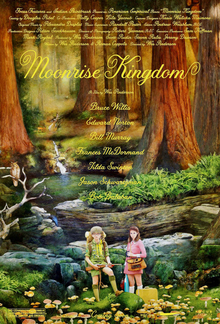
Movie Notes: Moonrise Kingdom


File:Moonrise Kingdom FilmPoster.jpeg

Moonrise Kingdom (2012)
Director: Wes Anderson

This movie was a blast.  I enjoyed myself so immensely while watching it that I had no time to stop and consider the meaning flowing underneath or the technique used in presenting it.  Still, I caught enough to know it was because of, and not in spite of, the meaning and art of the film that I so enjoyed it.

I'm not up to understanding or explaining everything that's going on in the film, so I won't try to spell it out.  This is a movie that taps into classical themes about leaving the city to renew the city, Biblical themes about a lost Eden, and a very modern aesthetic and moral compass.  It's so sweet and simple that it feels just like a kid's movie, but you can't take your kids to see it.  It's outrageous and fantastical with real and sympathetic characters making realistic, frustrating and heartwarming decisions.  It features severe disappointments but ends up optimistic.

And it's also a movie about the meaning and power of art -- especially film, but through the metaphor of music and painting.  If you enjoy -- or can even simply tolerate -- Wes Anderson's aesthetic, you should go see the movie.  There is some underage sexuality in the movie, so if that would bother you, you've been warned.

Tuesday, July 10, 2012

Movie Notes: Brave


File:Brave Teaser Poster.jpg

Brave (2012)
Director: Brenda Chapman and Mark Andrews

I never saw Cars 2 because the reviews were so poor, so my high expectations from Pixar have been forever lowered.  Brave surpassed these lowered expectations.  I was prepared to be critical of the film, but ended up wrapped up in the story and simply enjoying myself.  And, that's one of the things I'm looking for when I go to see a movie, so I have to say I liked the movie quite a bit.

That's not to say I liked everything about it.  I think there's wisdom in the old ideas of living to your place in the world.  Part of that involves a healthy degree of respect for one's parents.

I also think the reconciliation between Merida and her mother was more wish-fulfillment than meaningful art.  How many times in your relationships with other people have you had to give up little of what you'd like and receive exactly what you're looking for from them? 


Monday, July 09, 2012

Movie Notes: The Thief of Bagdad

I've decided to use the blog to post notes about movies that we've seen.  I used to use Flixter, but that app's been totally repurposed and is no longer suitable for my casual purposes.  You can expect to see a lot of movies posted about here, but don't expect anything insightful or incisive.  The purpose is just to jot down a few thoughts about the movie after watching it in the vein of a film diary.  I find taking notes help cement the films in my memory and it's nice to have some touchstone to check back on.

The Thief of Bagdad (1924)
Director: Raoul Walsh

This appears to be a pet project of Douglas Fairbanks.  He helped write, starred in, and produced the picture.  His energetic performance as the title character is certainly memorable, if dated; his wild gesticulations and stomping stride were appropriate to their time.  On the other hand, Sojin's more subtle performance as the sinister Mongol Khan is riveting even today.

Where Fairbanks excels is the physically demanding elements of his role.  He runs, jumps, swings, and swashbuckles his way through enormous sets.  It's good enough to inspire me to add his version of Robin Hood to our queue.

All in all, this film is a spectacle.  Fairbanks, gigantic detailed sets, fantastical creatures and effects, and chaste romance combine to make this a very entertaining film.  It's a bit on the long side, but I'd recommend it to fans of swashbucklers and film history.